Tired But Can't Sleep? Here's What's Actually Wrong
You're running on empty all day, but the second you lie down, your brain switches on. This isn't a willpower problem — it's a nervous system problem.
· 8 min read
Key Takeaway
It's Not You. It's Your Nervous System.
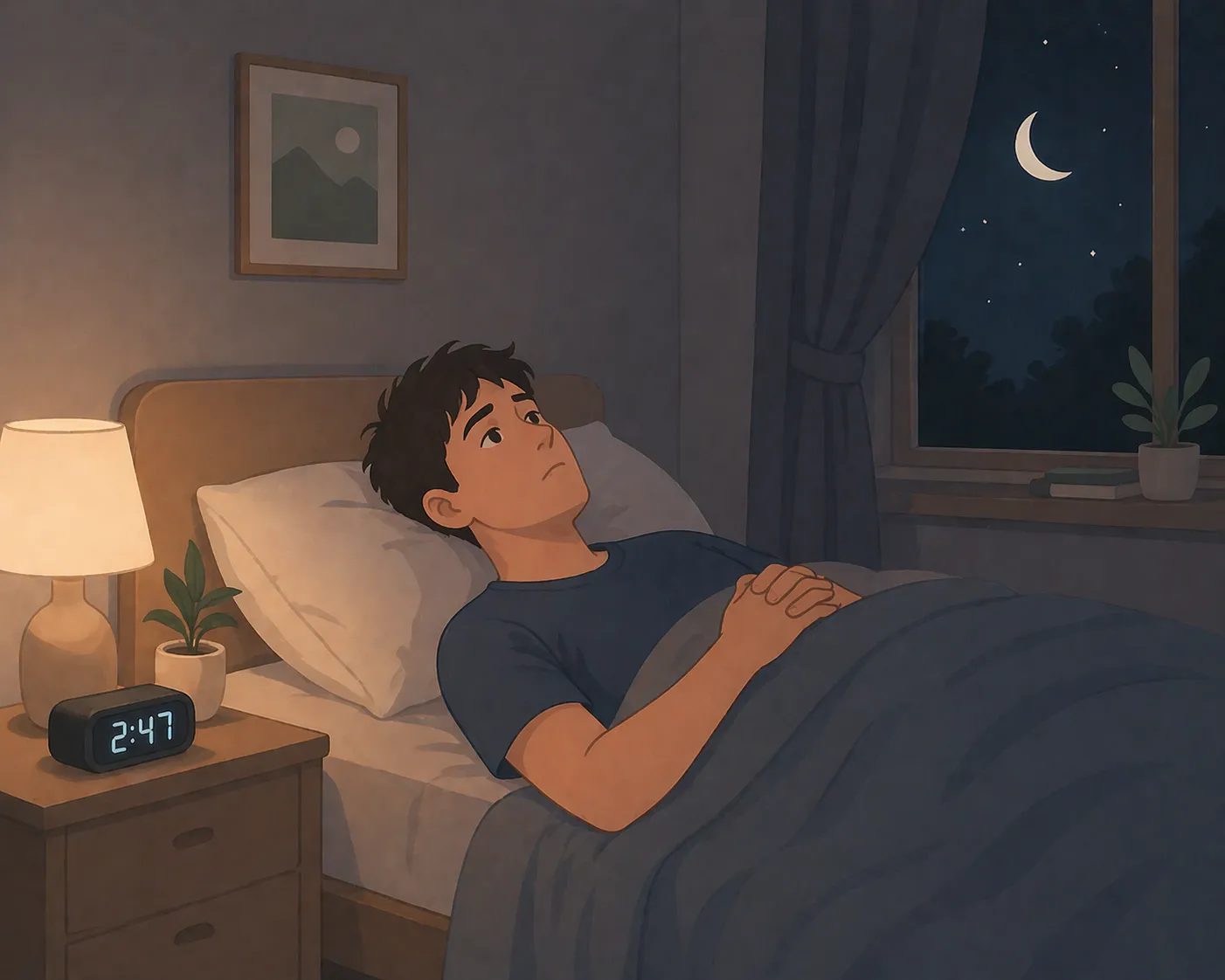
You know that specific kind of awful where you've been half-dead since 3 p.m., you finally get into bed — and then nothing. Eyes open. Brain fully online. Thoughts queuing up like they've been waiting for this moment all day.
Most people assume they just need to relax more, or put the phone down earlier, or try some new supplement. And those things aren't useless. But they're treating the wrong problem. The real issue is that your brain has two competing systems running at the same time, and the wrong one is winning.
Key Takeaway: Exhaustion and sleepiness are not the same thing. You can be physically wrecked while your brain stays locked in high-alert mode. Until you address the arousal system directly, no amount of chamomile tea is going to fix this.
The Two Systems Fighting Over Your Sleep
Sleep isn't something that just happens when you get tired enough. Two separate biological processes have to line up — and when they don't, you get the tired-but-wired state.
Your Sleep Drive: Building All Day
Every hour you're awake, your brain accumulates a chemical called adenosine — essentially a byproduct of being conscious. It builds up throughout the day and creates mounting pressure for sleep. By late evening, that pressure is significant. This is why pulling an all-nighter doesn't make the next night's sleep optional — your body is keeping score.
Caffeine, by the way, doesn't give you energy. It just blocks the adenosine receptors so you can't feel how tired you are. The debt accumulates anyway.
The Arousal System: The One Keeping the Lights On
On the other side is your wakefulness machinery — primarily driven by a brain chemical called orexin and your stress hormone cortisol. The orexin system actively reinforces vigilance. Under stress, it can override even high adenosine pressure and keep the brain in a state of alert. Research on orexin shows it functions less like an absence of sleepiness and more like an active lock on wakefulness.
Cortisol adds another layer. It follows a natural daily curve — including a modest rise in the evening — but chronic stress amplifies that spike. So at midnight, your adenosine is genuinely screaming for sleep while your cortisol system is quietly vetoing the whole thing.
That's the mismatch. High sleep pressure, high opposing arousal. The brain never crosses the threshold.
Three Ways Your Brain Stays Switched On
Sleep clinicians split hyperarousal into three overlapping types. Most people dealing with this pattern have at least two going at once.
The Brain That Won't Stop Problem-Solving
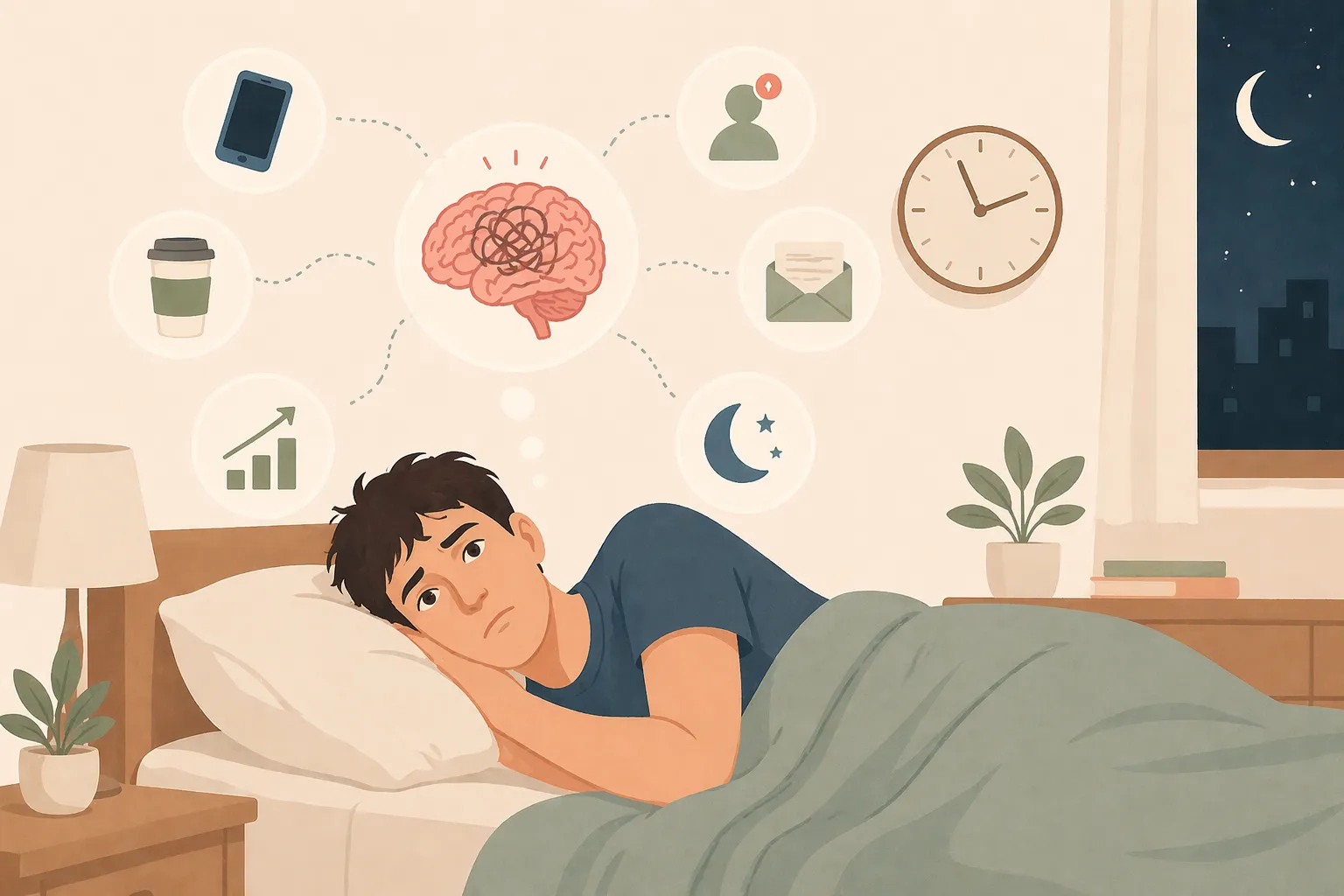
Your prefrontal cortex — the planning, analyzing, catastrophizing part — is supposed to go relatively quiet as you approach sleep. Instead, it decides bedtime is the ideal moment to process everything unresolved from the day. The to-do list. The conversation that went weird. The calculation of exactly how many hours of sleep you'll get if you fall asleep right now.
This isn't random. The brain, when it senses low stimulation, often defaults to threat-scanning. Lying in a dark quiet room triggers that mode just as reliably as actual danger does. The prefrontal cortex running problem-solving mode is biologically incompatible with sleep onset — you literally cannot think your way into sleep.
The Fear of Not Sleeping (That Makes It Worse)
Here's the cruel part: anxiety about sleep directly causes more sleep problems. The moment you start watching the clock and calculating remaining hours, you've created a secondary threat. Your brain responds to "I'm not asleep yet" the same way it responds to any threat — more arousal, more alertness, harder to fall asleep.
This is how short-term insomnia becomes chronic. The original cause — a stressful week, illness, travel — resolves. But the conditioned association between bed and anxiety remains. Now the bed itself is the trigger.
The Body Carrying the Day's Tension
Beyond the mental layer: elevated resting heart rate, tight jaw and shoulders, low-grade sympathetic nervous system activation. Sleep requires a shift toward parasympathetic mode — rest and digest. If your body is still running on adrenaline residue from the day, that shift doesn't happen cleanly.
EEG studies show that people with chronic insomnia have measurably elevated high-frequency brain activity even during sleep. The cortex never fully powers down. This isn't subjective. It shows up in the data.
Vietnam Perspective: Da Nang doesn't wind down at 9 p.m. — the noise, the heat, the low-grade stimulation of city life here is its own kind of physiological arousal that follows you to bed. The two things that have made the biggest difference for me cost almost nothing: a desk fan pointed at the bed (core body temperature needs to drop to initiate sleep — this helps fast), and treating the 30 minutes before bed like a genuine transition, not just the end of screen time. The nervous system needs a signal that the day is actually over.
What Keeps Fueling the Cycle
A few specific habits are worth calling out because they're extremely common and most people don't connect them to this problem:
Caffeine after 2 p.m. Its half-life is 5–7 hours. A 3 p.m. coffee still has significant adenosine-blocking effect at 9 p.m. — exactly when you need that sleep pressure to be working for you.
Evening alcohol. It's sedating in the first half of the night and activating in the second. You might fall asleep fast and wake up at 3 a.m. feeling awful and wired. This is not a mystery — it's the alcohol metabolizing.
Irregular wake times. Sleeping in on weekends or napping late bleeds off your adenosine pressure so there's less of it doing its job at actual bedtime. Consistency of wake time matters more than consistency of bedtime.
Chronic unresolved stress. Not just "a hard week" but sustained low-level stress that keeps the HPA axis slightly activated day after day. This is the one most people underestimate because it becomes background noise.
What Actually Works
Here's what the research is clear on: standard sleep hygiene — dark room, no phone, consistent bedtime — helps at the margins but doesn't fix a hyperaroused nervous system. Those are supporting conditions, not a treatment. The things that actually move the needle:
CBT-I: The Thing Worth Trying Before Anything Else
Cognitive Behavioral Therapy for Insomnia consistently outperforms sleep medication in long-term outcomes — including in head-to-head trials. The evidence base is solid. It works by targeting all three arousal types: restructuring catastrophic sleep beliefs, breaking the conditioned bed-anxiety association, and using sleep restriction to rebuild genuine homeostatic pressure.
Most people skip it because it has a counterintuitive early phase where you feel more tired before things improve. That's the point — you're actually building real sleep pressure. General CBT practices that also show up in CBT-I or support it:
Cognitive restructuring — identifying automatic negative thoughts ("I'll never sleep properly again"), testing whether they're accurate, and replacing catastrophic interpretations with more realistic ones. The core CBT skill.
Behavioral activation — staying active and engaged during the day to regulate mood and energy, which indirectly supports the sleep-wake cycle.
Worry scheduling — containing rumination to a specific 15-minute window earlier in the day so it doesn't follow you to bed. You're not suppressing the worry, you're relocating it.
Relaxation training — progressive muscle relaxation or diaphragmatic breathing, used to reduce physiological arousal. Standard CBT toolkit, directly applicable before sleep.
Thought records — writing down anxious thoughts, the evidence for and against them, and a more balanced response. Slower and more structured than quick restructuring; useful if the cognitive loop is deeply entrenched.
See our guide on starting CBT-I without a therapist if you want the practical breakdown.
Actively Downregulating Before Bed
The goal isn't to relax harder — it's to give your nervous system specific inputs that signal the threat is over and it's safe to let go. A few that work:
Physiological sigh. Double inhale through the nose, long slow exhale through the mouth. Repeat 3–5 times. This offloads CO2 faster than normal breathing and triggers a measurable parasympathetic response. It's the fastest nervous system reset I've found.
Worry dump. Five minutes before bed writing down every open loop — tasks, worries, unresolved thoughts. Close the notebook. This isn't journaling therapy; it's offloading the cognitive queue so the prefrontal cortex stops running it in the background.
Fixed wake time. Non-negotiable. Pick one and hold it regardless of when you fell asleep. This is the single highest-leverage sleep habit because it anchors your circadian rhythm and ensures adenosine actually builds across the day.
Try This Tonight: Before bed, spend 5 minutes writing down everything open in your head — tasks, worries, anything unfinished. Then do 5 physiological sighs. That's it. You're directly addressing cognitive and physiological arousal without any supplements, apps, or routines. Do it for a week before adding anything else.
The Bottom Line
If you're exhausted but can't sleep, your body is not broken and you're not doing relaxation wrong. You have genuine sleep pressure — adenosine is doing its job. The problem is a nervous system that hasn't gotten the signal that the day is done.
Start with one thing: a fixed wake time tomorrow, held regardless of tonight. Then add the worry dump and physiological sigh before bed. That's a complete first intervention. If nothing shifts after two consistent weeks, look into CBT-I — it's the most evidence-backed tool available and most people have never heard of it. That's where to go next.
Science Note
Try This
FAQ
Why am I so tired all day but can't sleep at night?
This is the tired-but-wired pattern, and it comes down to two competing systems. Your sleep drive is high — adenosine has been building all day and your body is genuinely exhausted. But your arousal system is also high, driven by cortisol, stress, or anxious thoughts, and it's overriding the sleep signal. The fix isn't more tiredness — it's learning to lower the arousal side of the equation through things like CBT-I, consistent wake times, and pre-bed nervous system downregulation.
Is it normal to feel exhausted but unable to fall asleep?
Yes, and it's more common than most people realize. It's also consistently misunderstood as a relaxation problem when it's actually a nervous system regulation problem. The experience is real and physiologically explainable — it's not anxiety inventing a problem. That said, if it's happening most nights for more than a few weeks, it's worth addressing deliberately rather than hoping it resolves. Consistent lifestyle changes help, but if the pattern is entrenched, CBT-I is the most reliable intervention available.
What does it mean when your body is tired but your mind is wide awake?
It usually means your prefrontal cortex is stuck in active mode — planning, problem-solving, or threat-scanning — when it should be quieting down. This cognitive arousal is often driven by stress or rumination during the day that never got resolved. EEG studies actually show elevated high-frequency brain activity in people with insomnia even during sleep, meaning the cortex doesn't fully power down even when the body is resting. CBT-I specifically targets this pattern and has the strongest evidence base for resolving it.
Can anxiety cause exhaustion but inability to sleep?
Directly, yes. Anxiety activates the stress-response system, raises cortisol, increases heart rate, and keeps the sympathetic nervous system active — all of which work against the parasympathetic shift sleep requires. Anxiety also creates a secondary loop specifically around sleep: worrying about not sleeping becomes its own arousal trigger, making sleep harder, which creates more anxiety. This feedback loop is one of the main reasons insomnia becomes self-sustaining long after the original stressor is gone.
Does sleep hygiene actually help when you're tired but can't sleep?
Partially. The standard recommendations — dark cool room, consistent bedtime, no screens — create better conditions for sleep but don't fix a hyperaroused nervous system on their own. Think of them as removing obstacles rather than solving the problem. The one habit with the strongest standalone evidence is a fixed wake time, because it anchors your circadian rhythm and ensures adenosine pressure builds properly throughout the day. If hygiene alone hasn't worked after a few weeks of consistency, CBT-I is the next step.
How do I stop my brain from racing when I'm trying to sleep?
The most effective approach is to offload the mental queue before you try to sleep rather than fighting it in bed. A five-minute worry dump — writing down every open task, concern, and unresolved thought before bed — has solid evidence behind it for reducing sleep-onset cognitive arousal. Physiological sighs (double inhale, long exhale, repeated several times) provide a fast physiological reset. Longer term, CBT-I's cognitive restructuring component addresses the underlying catastrophic thought patterns rather than just managing symptoms night to night.
What is paradoxical insomnia?
Paradoxical insomnia is when someone genuinely feels like they've been awake all night, but sleep studies show their actual sleep duration is close to normal. It's caused by such persistent cortical arousal that the brain keeps processing stimuli even during light sleep, essentially misregistering sleep as wakefulness. If you regularly feel like you got zero sleep but still function reasonably the next day, this mechanism may be partly at play. The behavioral fixes — particularly CBT-I — are similar to standard insomnia treatment, but knowing about this condition can reduce the anxiety around perceived sleep loss.
Biohacking without the $10K budget
Get practical weekly insights on sleep, gut health, and mindset, built for real life in Southeast Asia and beyond.
Subscribe freeRelated Articles
How Physical Health Quietly Shapes Your Mental State
Your mindset isn't just in your head. Sleep, gut signaling, and daily habits are quietly running the show — here's the science behind it.